
Overview
Estimated time: 1.5 hours
Language: Spanish
Date: 2026
Format: online, self-paced
Code: RGNPVG2004
Intended for: farmers, technical advisors, agricultural professionals, advanced students and companies in the agricultural sector interested in organic and regenerative systems, and in transition strategies towards more sustainable, resilient and stable production models.
Description:
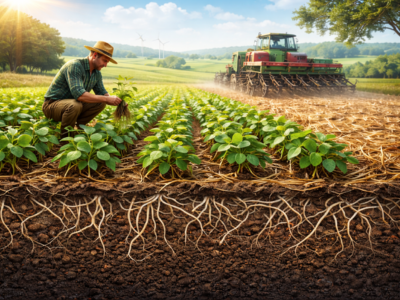
This course offers a technical, critical and applied analysis of the relationship between Organic Agriculture and Regenerative Agriculture, highlighting where they converge and where they clash in practice, especially around no-till farming and weed management without pesticides. Building on regenerative principles (permanent cover, diversity, living roots and minimal disturbance) and on the constraints of organic systems (no synthetic herbicides or pesticides), it discusses how to design a viable production system that moves towards organic no-till, or “functional no-till”.
The applied core of the course is a real case study: the instructor’s experience over 6 seasons of organic soybean production at Chalé do Seival (Brazil), with its main management decisions, difficulties (operating windows, weed pressure, extreme weather) and room for improvement. By the end, participants will have a clear conceptual framework and a set of concrete tools to plan transition strategies and design organic-regenerative systems adapted to different environments.
Learning outcomes:
By the end of this course, you should be able to:
- Clearly distinguish the principles of Organic Agriculture and Regenerative Agriculture, identifying synergies and conflicts in system design.
- Analyze the challenge of no-till farming without pesticides, understanding the role of weed management, the seed bank and operating windows.
- Design a basic scheme that combines tools (service/cover crops, mechanical termination, rotations, crop competition and precision mechanical interventions) to move towards functional organic no-till.